Back
Space
QVersion

A New Window to Space: How QVersion Is Opening Up an Untapped Wavelength for Optical Communication

May 18, 2026
Credits: Qvversion

What if there was an entirely unexplored wavelength range that could transform how satellites, aircraft, and ground stations communicate, and the only thing missing was a light source small enough to use? That's the gap QVersion is closing. And with ESA Spark Funding, they're about to hand engineers their first real tool to find out.

The Company: QVersion

QVersion is a spin-out from Aarhus University, founded by researchers with deep expertise in nonlinear optics and photonic integration. Their core technology is based on a process called difference frequency generation (DFG); a method that converts standard, commercially available near-infrared laser light into tunable mid-infrared output.

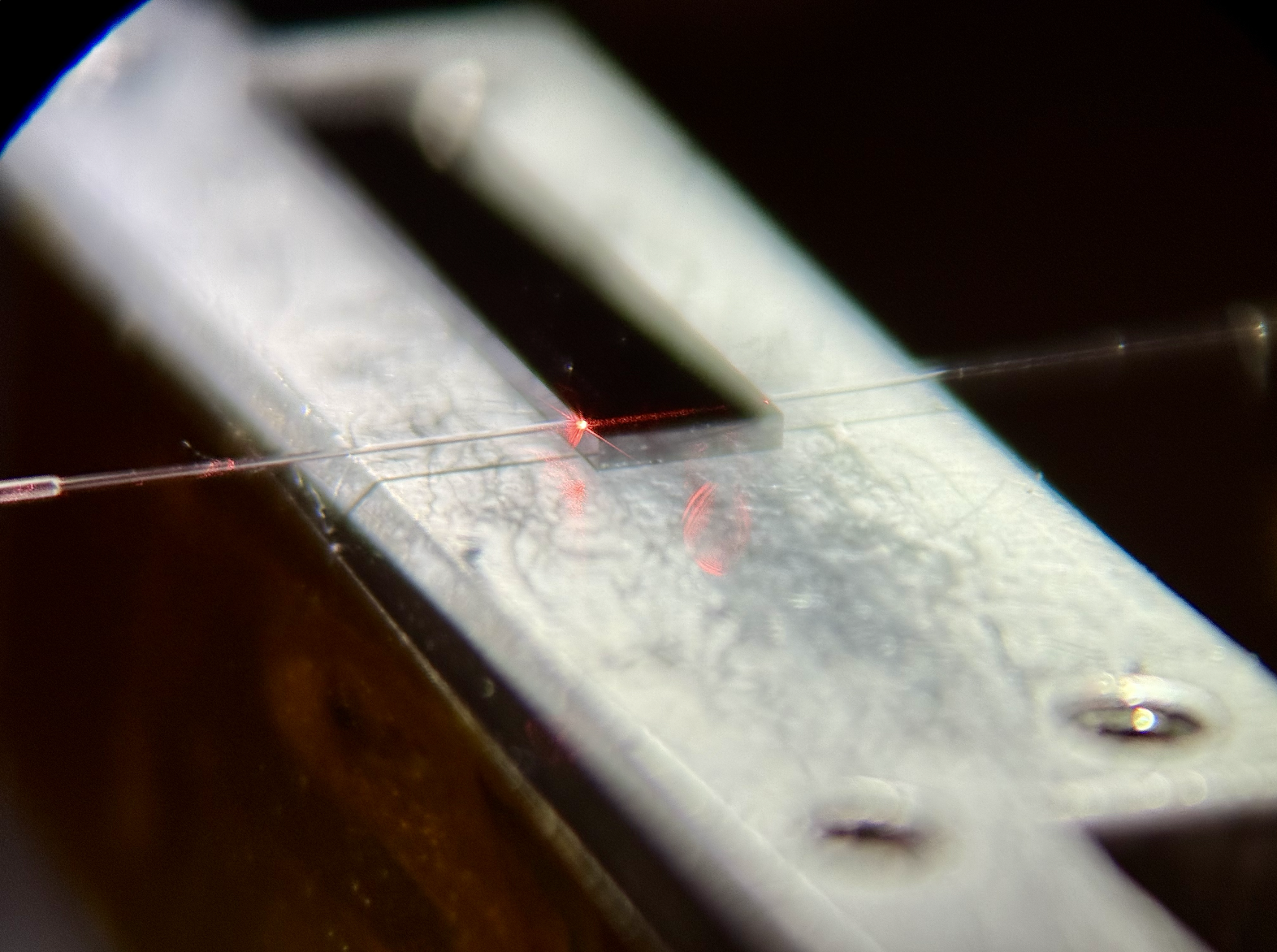
The results fits on a compact chip that can fit on the tip of your finger. This tiny module produces laser light across the 8–9 µm mid-infrared range with a high degree of tunability and precision. These properties have already proven valuable in non-space applications such as gas detection, environmental monitoring, and industrial process control.

Now, with their ESA Spark Funding project, QVersion is adapting that same chip-scale platform for a very different challenge: optical communication links that must travel through the atmosphere between satellites, aircraft, high-altitude platforms, and ground stations.

The Challenge: A Spectrum Left Unexplored

Long-distance communication between space and Earth relies almost entirely on radio-frequency (RF) technology. RF systems are mature and dependable, but they have real limits. The radio spectrum is increasingly congested, available bandwidth is finite, and signals can be disrupted by interference or deliberate jamming.

Free-space optical communication is a compelling alternative. It supports far higher data rates, is more directional, and is much harder to intercept. Most optical systems today operate at visible or near-infrared wavelengths, where hardware is widely available. But these shorter wavelengths come with their own drawbacks: sensitivity to atmospheric conditions and strict requirements for precise pointing between terminals.

The mid-infrared range, around 8 to 9 micrometres, sits within atmospheric transmission windows that could offer more favourable propagation for space-to-ground and space-to-air links. Despite this potential, the band has seen almost no practical exploration. The reason is simple: no compact, tunable, system-compatible light source has existed in this range. Without a usable source, engineers cannot test whether mid-infrared optical links would actually outperform existing approaches. QVersion is about to change that.

The Spark Funding Project: WINDOW

QVersion's ESA Spark Funding project is called WINDOW — Wavelength-selective Integrated Nonlinear Devices for Optical Wireless links.

Over 12 months, QVersion build and validate a laboratory breadboard based on their chip-scale platform, demonstrating stable, tunable mid-infrared emission across the 8–9 µm band. The team will also engage with stakeholders across the space and photonics sectors to validate the technology's relevance and sharpen their value proposition for space communication applications. The goal by the project's end: a working mid-infrared source that researchers and engineers can use to begin testing communication concepts in this wavelength range, for the very first time.

Why This Matters: Unlocking a New Design Space

What matters most about WINDOW is not just the device itself, it's what it unlocks. Today, engineers designing optical links for space and near-space applications have no practical way to experiment with mid-infrared concepts in the lab. Their design choices are constrained by what sources already exist, not by what the underlying physics might allow. QVersion's breadboard changes this entirely.

"If it works on Earth, use it for space."

That's the logic of ESA Spark Funding. and QVersion is opening a window that no one has been able to look through before

QVersion is one of four companies currently supported through the ESA Spark Funding programme in Denmark, managed by ESA Technology Broker Denmark at DTU. Spark Funding provides up to €75,000 in co-funding for companies transferring proven non-space technologies into space applications.

Is your company's technology ready for space? Find out more about ESA Spark Funding →www.spaceventures.dk/companies/spark-funding

Marta Pareja Boto
ESA BIC Student Assistant

Related articles

All
One Chip to Rule Them All: How Spasic Is Simplifying Satellite Power Monitoring

May 18, 2026

Case study
Space
A New Window to Space: How QVersion Is Opening Up an Untapped Wavelength for Optical Communication

May 18, 2026

Case study
Manufacturing
Seeing Inside the Invisible: How NORBLIS Is Bringing Laser Precision to Space Manufacturing

May 14, 2026

Case study
Space
Drones & Robotics
From Drones to Orbit: How Skypuzzler Is Taking Airspace Management to Space

May 10, 2026

Case study
Agriculture
NAUST Robotics: Revolutionizing Agriculture with Autonomous Drones

Apr 17, 2026

Case study
Manufacturing
Graphene Solutions for a Sustainable Future

Feb 27, 2026

Case study
All
Watch it now: Information Meeting on Danish Public Funding Opportunities for Space

Jan 12, 2026

Insight
Agriculture
Laser Precision for a Chemical‑Free Field

Jan 5, 2026

Case study
Space
Bringing 5G Thinking to Low‑Earth Orbit

Dec 30, 2025

Case study
Environment
Turning Satellite Data into Biodiversity Intelligence for Cities

Dec 29, 2025

Case study
Manufacturing
Making "right pallet, right place, right truck" the rule.

Dec 23, 2025

Case study
Manufacturing
Mobile 3D Printing for Concrete Today, Lunar Construction Tomorrow

Dec 19, 2025

Case study
Environment
Protecting Denmark's nature with satellite and artificial intelligence

Dec 18, 2025

Case study
Environment
Using Space Technology to Clean the Arctic

Dec 18, 2025

Case study
All
Strong growth in Danish space-based startups

Nov 28, 2025

Insight
All
The Future of Space-Based Startups in Europe

Aug 29, 2025

Insight
Manufacturing
ThiaX provides real-time, non-destructive X-ray mapping of strain and crystallinity in polymers and composites

Jul 24, 2025

Case study
Drones & Robotics
AI-driven off-road autonomy software for unmanned ground vehicles on the modern battlefield

Case study
AI & Big Data
Security
Securing industrial IoT through decentralized data integrity

Case study
Drones & Robotics
Smart solutions for year-round outdoor cleaning

Case study
AI & Big Data
High efficiency compression for energy IoT and space applications

Case study
Drones & Robotics
Security
Smart identification systems for drones and airspace safety

Case study
Agriculture
Geospatial and climate model integration for agricultural finance

Case study
Drones & Robotics
Autonomous operation software for agricultural machines

Case study
Healthcare
Durable chemical free biofilm protection for materials

Case study
Drones & Robotics
Electric cargo drone systems for efficient air freight

Case study
Space
Field ready handheld chemical analysis devices

Case study
Space
Human centered design for future space habitats

Case study
Space
A one-stop shop for Composite structures in Space, with in-house design, manufacturing & testing

Case study
Drones & Robotics
Secure and efficient flight management with multispectral imaging

Case study
N/A
Comprehensive performance data for horse riders and trainers

Case study
Infrastructure
Digital solutions for smart cities and communities

Case study
Healthcare
Smart medical devices for respiratory care

Drones & Robotics
Data driven market intelligence for industrial wastewate

Case study
Agriculture
Satellite enabled smart scheduling for farm management

Case study
Space
X-ray optics design and thin film coating solutions

Case study
Maritime
Drones & Robotics
Galileo enabled drone systems for maritime operations

Case study
Fintech
Fintech for liquid and sustainable forest assets

Case study
Healthcare
Assistive navigation solutions for the visually impaired

Case study
Drones & Robotics
Airborne antenna testing for global SatCom applications

Case study
Infrastructure
Smart GPS tracking for personal and business assets

Case study
Maritime
Maritime connectivity through LEO satellites

Case study
Infrastructure
Digital infrastructure for cities and municipalities

Case study
Agriculture
Early detection of crop threats through data-driven insights

Case study
Drones & Robotics
Autonomous platforms for repetitive and dangerous tasks

Case study
Agriculture
Cloud-free satellite imagery for urban and landscape monitoring

Case study
Drones & Robotics
High-end flight termination systems for safe drone operations

Case study
Maritime
Robotic solutions for maritime tasks

Case study
Agriculture
Drones & Robotics
Drone imagery analysis for crop and weed detection

Case study
Space
Non-destructive testing using terahertz lightwaves

Case study
N/A
Rapid installation of screw pile foundations

Case study
Space
Chemical Propulsion For Microsatellites

Case study
Environment
Using earth observation to guide peatland restoration

Case study
Space
Advancing space-based materials and microdevice development

Case study
Maritime
Searchlights designed for safety and rescue at sea

Case study
Education
Science experiments made simple for the classroom

Case study
Environment
Drones & Robotics
Security
Reducing wildfire impact with autonomous technology

Case study
Security
Maritime
How Danish Company Tordenskjold Uses Satellite Technology to Enhance Maritime Security

Case study
Maritime
Sensemakers is Transforming the Danish Maritime Environment Using Space

Case study
Manufacturing
From road to orbit: How AIRY’s additive manufacturing for EVs is now building lightweight structures for satellites

Case study
Infrastructure
InnoPilot Leverages Space Technology to Keep Critical Infrastructure Safe and Connected

Case study
Healthcare
How Yuman frees up nurses using robots assistants integrated with GNSS

Case study
Fintech
From Space to Shipping Markets: How Danish Company Navi Merchant Uses Satellite Data to Predict Freight Prices

Case study
Environment
How Klimate uses space to verify forest carbon dioxide removal

Case study
Energy
Aerial Tools Uses Satellite Technology to Improve Energy Efficiency and Solar Maintenance

Case study
Drones & Robotics
How using satellite data helps HectoDrone to map environmental challenges and carry out surveillance in cold isolated areas like Greenland

Case study
AI & Big Data
Atla.ai Turns Satellite Data into Actionable Insights with AI

Case study
Agriculture
PerPlant Uses Space Technology to Make Precision Agriculture Accessible to All Farmers

Aug 1, 2025

Case study
All
What is a space connection?

Apr 28, 2025

Insight